メニュー
JP | JPY
-
-
-
- Challenges and Chances: A Review of the 1st Stem Cell Community Day
- Summertime, and the Livin’ Is Easy…
- Follow-on-Biologics – More than Simple Generics
- Bacteria Versus Body Cells: A 1:1 Tie
- Behind the Crime Scene: How Biological Traces Can Help to Convict Offenders
- Every 3 Seconds Someone in the World Is Affected by Alzheimer's
- HIV – It’s Still Not Under Control…
- How Many Will Be Convicted This Time?
- Malaria – the Battle is Not Lost
- Physicians on Standby: The Annual Flu Season Can Be Serious
- At the Forefront in Fighting Cancer
- Molecular Motors: Think Small and yet Smaller Again…
- Liquid Biopsy: Novel Methods May Ease Cancer Detection and Therapy
- They Are Invisible, Sneaky and Disgusting – But Today It’s Their Special Day!
- How Many Cells Are in Your Body? Probably More Than You Think!
- What You Need to Know about Antibiotic Resistance – Findings, Facts and Good Intentions
- Why Do Old Men Have Big Ears?
- The Condemned Live Longer: A Potential Paradigm Shift in Genetics
- From Research to Commerce
- Chronobiology – How the Cold Seasons Influence Our Biorhythms
- Taskforce Microbots: Targeted Treatment from Inside the Body
- Eyes on Cancer Therapy
-
-

-
-
-
- Challenges and Chances: A Review of the 1st Stem Cell Community Day
- Summertime, and the Livin’ Is Easy…
- Follow-on-Biologics – More than Simple Generics
- Bacteria Versus Body Cells: A 1:1 Tie
- Behind the Crime Scene: How Biological Traces Can Help to Convict Offenders
- Every 3 Seconds Someone in the World Is Affected by Alzheimer's
- HIV – It’s Still Not Under Control…
- How Many Will Be Convicted This Time?
- Malaria – the Battle is Not Lost
- Physicians on Standby: The Annual Flu Season Can Be Serious
- At the Forefront in Fighting Cancer
- Molecular Motors: Think Small and yet Smaller Again…
- Liquid Biopsy: Novel Methods May Ease Cancer Detection and Therapy
- They Are Invisible, Sneaky and Disgusting – But Today It’s Their Special Day!
- How Many Cells Are in Your Body? Probably More Than You Think!
- What You Need to Know about Antibiotic Resistance – Findings, Facts and Good Intentions
- Why Do Old Men Have Big Ears?
- The Condemned Live Longer: A Potential Paradigm Shift in Genetics
- From Research to Commerce
- Chronobiology – How the Cold Seasons Influence Our Biorhythms
- Taskforce Microbots: Targeted Treatment from Inside the Body
- Eyes on Cancer Therapy
-
-
JP | JPY
Sorry, we couldn't find anything on our website containing your search term.
60-Year Anniversary of a Pipetting Masterstroke
SIMON PLATE Lab Academy
- バイオテクノロジー
- 実験室の日常業務
- ピペッティングと分注
- 実験室の日常
- 効率
- ピペット
- リキッドハンドリングワークステーション
- BioNews article
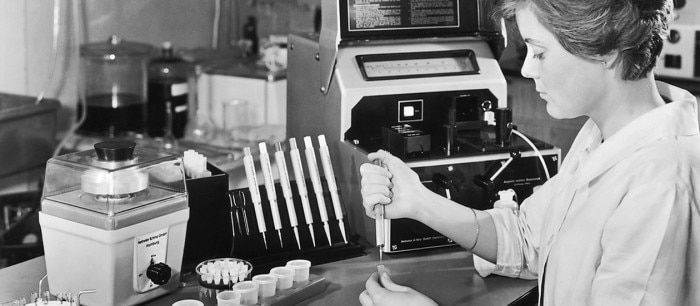
2021 marks a key milestone for anyone working in a lab. 60 years ago, Eppendorf changed the ways of liquid handling forever with a new product type that enables today’s scientists to talk and pipette simultaneously! In 1958, German physician Heinrich Schnitger at the University of Marburg filed for a patent describing a “device for the fast and exact pipetting of small liquid volumes”. Eppendorf recognized the potential and developed it into the first industrially manufactured piston-stroke pipette.
This article appeared first in BioNews, Eppendorf’s customer magazine since 1993.
もっと読む
A world first
Launched in 1961, Eppendorf’s “Marburg Pipette” featured the same basic elements to those found in today’s labs: a spring-loaded piston that stops exactly at a set volume level and a removable plastic tip. This alternative to cumbersome and risky mouth pipetting with glass tube pipettes changed the face of pipetting forever.
The new piston-stroke pipette paved the way for modern clinical analytics and biochemical research by enabling safe, easy, and accurate liquid handling in the microliter range. With its
launch and the complementary reaction tubes (launched in 1963), which are known around the world as Eppendorf Tubes® (or “Eppi®”), Eppendorf laid the foundation of its premium liquid handling business.
Continuing innovation
Since then, by applying our proven expertise and innovation, Eppendorf has continued to set industry standards in precise manual and automated dispensing of small volumes. For example, in 1978, we redefined liquid handling again with the introduction of the Multipette® (US/CAN: Repeater® ) pipette with Combitips® tips system – the first handheld repetitive dispenser and an entirely new concept of disposable tips with integrated pistons.
We have always worked closely with our customers to understand their precise needs and develop the right pipette or solution for every application. Through this partnership, we recognized the growing requirement for increased throughput with the arrival of 96-well plates, and in 1994 launched the Titerman, our first manual multi-channel pipette for high sample throughput.
Still accelerating research
Over the years we have continued to evolve the pipette through the advent of electronic pipetting and automated liquid handling systems for the utmost reproducibility of micro- and nanoliter volumes. And in today’s digital era, Eppendorf is still setting liquid handling benchmarks to meet the needs of future lab work. Our latest introduction in pipetting connectivity – the VisioNize® pipette manager – is designed to redefine speed and workflow management to further accelerate research.
At Eppendorf, we combine state-of-the-art instruments, high-quality consumables, and leading added-value services to ensure that the past, present, and future of pipetting continues in safe hands.
もっと読む
Related Documents
- Magazine | BioNews 55 (July 2021)
もっと読む